Why UV LED Curing Is Becoming a Strategic Industrial Technology
In industrial manufacturing, curing is often an invisible step, but it is one of the most critical. It directly affects product durability, production speed, energy consumption, and overall process reliability.
Over the past decade, UV curing has moved from being a specialized solution used in a few sectors to a widely adopted industrial technology. Today, with the rapid evolution of UV LED systems (UVA and UVC), it is enabling manufacturers to rethink entire production workflows.
Unlike traditional mercury lamps, UV LED technology offers a level of control that aligns with modern industrial requirements: stable emission, instant activation, reduced heat impact, and significantly lower maintenance. These characteristics are not just incremental improvements, they open the door to applications that were previously impractical or economically unfeasible.
As of today, companies are no longer asking if UV curing can be integrated into their processes, but rather how far it can be pushed, especially in sectors where speed, precision, and sustainability are becoming decisive factors.
What Is UV Curing and How It Works
UV curing is a photochemical process in which ultraviolet radiation activates specific molecules — photoinitiators — within inks, coatings, or adhesives. Once activated, these molecules trigger a rapid polymerization reaction that transforms liquid formulations into solid, highly resistant materials.
From an industrial perspective, what makes this process particularly attractive is not just its speed, but its controllability. By selecting precise wavelengths—typically in the UVA range for curing (315–400 nm) and UVC for germicidal applications (200–280 nm)—it is possible to tailor the reaction to the material and the production environment.
This level of control is exactly where UV LED systems outperform traditional technologies. Instead of broad-spectrum emission, LEDs provide narrow, stable wavelengths that can be matched to specific chemistries, improving efficiency and repeatability.
Core Industrial Applications of UV LED Curing
– Printing and Graphic Arts
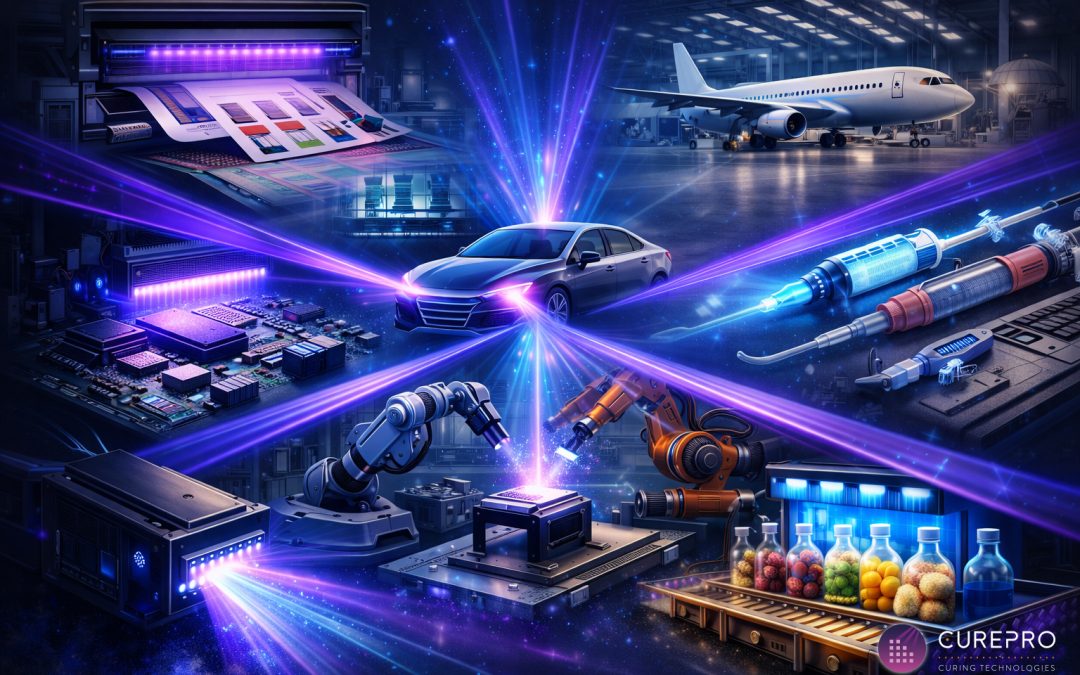
One of the most established and mature applications of UV curing is in the printing industry. From flexographic and offset printing to digital inkjet systems, UV curing enables instant drying of inks directly on the substrate.
This has a direct impact on productivity. Since there is no need for solvent evaporation or long drying times, production lines can operate at significantly higher speeds while maintaining consistent quality. Moreover, UV-cured inks adhere effectively to non-porous materials such as plastics, metals, and glass, expanding the range of printable substrates.
The transition to UV LED systems in this field has further improved energy efficiency and process stability, making them the preferred choice in modern print environments.
– Industrial Coatings on Wood, Plastic, and Metal
In coating applications, UV curing is widely used to enhance surface properties such as scratch resistance, chemical durability, and visual finish. Industries ranging from furniture manufacturing to automotive components rely on UV-cured coatings to achieve consistent and high-performance results.
What makes UV LED particularly valuable here is the ability to work with heat-sensitive materials. Traditional thermal curing can deform or damage substrates, while UV LED systems allow for precise curing with minimal thermal impact.
This has enabled more compact production lines, reduced energy consumption, and greater flexibility in process design, especially in automated environments.
– Adhesives and Bonding in Industrial Assembly
UV-curable adhesives have become essential in applications where precision and speed are critical. In electronics, optics, and medical device manufacturing, bonding often needs to occur in confined spaces and with tight tolerances.
UV LED curing allows for highly controlled reactions. The adhesive remains stable until exposed to light, which means curing can be activated exactly where and when it is needed. This eliminates the need for complex masking processes and reduces waste.
In micro-scale assemblies, where even minimal heat can compromise components, the low thermal output of UV LEDs becomes a decisive advantage.
– Electronics and Semiconductor Manufacturing
As electronic devices become smaller and more complex, manufacturing processes require increasing levels of precision. UV curing plays a role in several stages, including conformal coatings, encapsulation, and specialized photochemical processes.
The stability of UV LED output is particularly important in this context. Consistent irradiance ensures repeatable results, which is essential in high-volume production environments. Additionally, the compact nature of LED systems makes them easier to integrate into cleanroom setups and automated lines.
– Medical Devices and Healthcare Manufacturing
In the medical field, curing processes must meet strict requirements in terms of cleanliness, precision, and material compatibility. UV curing is used in the assembly of devices such as catheters, syringes, diagnostic cartridges, and wearable sensors.
Because UV-curable systems do not rely on solvents, they reduce the risk of contamination and support biocompatibility standards. At the same time, the ability to cure adhesives and coatings quickly and locally makes them ideal for delicate components and microfluidic systems.
UVC Applications:
– Sterilization and Surface Decontamination
Beyond curing, ultraviolet technology plays a critical role in sterilization. UVC radiation, in particular, is widely used to inactivate microorganisms by damaging their DNA or RNA, preventing replication.
This principle is applied in industrial environments for air purification, water treatment, and surface decontamination. From HVAC systems to pharmaceutical packaging lines, UVC solutions are increasingly integrated into processes where hygiene is essential.
The shift from mercury-based systems to UVC LEDs is accelerating due to regulatory pressure and the need for safer, more sustainable technologies. UV LED systems offer immediate operation, easier integration, and eliminate the risks associated with mercury.
Learn more about CurePro UVC Technology
Emerging and Advanced Applications of UV LED Technology
– Additive Manufacturing and 3D Printing
UV-based 3D printing technologies, such as stereolithography (SLA) and digital light processing (DLP), rely heavily on controlled light exposure to build objects layer by layer.
The precision of UV LED systems enables higher resolution and faster curing cycles, making them increasingly relevant not only for prototyping but also for industrial production.
– Advanced Materials and Functional Coatings
Recent research and industrial development have expanded the use of UV curing into advanced materials. These include nanocomposites, antimicrobial coatings, and functional surfaces with properties such as conductivity or self-healing behavior.
Such applications depend on highly controlled irradiation conditions, where UV LED systems provide a level of tuning that is difficult to achieve with conventional technologies.
– Automotive, Aerospace, and Lightweight Materials
In sectors where weight reduction and material performance are critical, UV curing is finding new applications in composite materials, structural bonding, and protective coatings.
The ability to reduce curing times while maintaining material integrity makes UV LED systems particularly attractive in these high-performance environments.
– Food Industry and Packaging Innovation
The food and packaging industries are increasingly adopting UV technologies not only for sterilization but also for coatings and printing processes that must comply with strict safety standards.
UV LED systems support low-migration inks and coatings, enabling safer packaging solutions while improving production efficiency.
– Textile and Functional Surfaces
Emerging applications in textiles include UV-cured inks and coatings that provide functional properties such as water resistance or antimicrobial behavior. These developments are still evolving but show strong potential for industrial scaling.
Why UV LED Is Replacing Traditional Mercury Lamps
The shift toward UV LED technology is not driven by a single factor, but by a combination of industrial and regulatory pressures.
Manufacturers are seeking greater process control, lower energy consumption, and reduced maintenance requirements. At the same time, environmental regulations are limiting the use of mercury-based systems.
UV LEDs respond to these needs by offering predictable performance, long operational lifetimes, and compatibility with modern automated production lines. As a result, they are rapidly becoming the new standard across multiple industries.
Discover more about UV LED vs Mercury Lamp Curing in this article from our blog.
How CurePro UV LED Systems Adapt to Industrial Needs
Every industrial process has its own constraints, and curing is no exception. Geometry, materials, production speed, and environmental conditions all influence the effectiveness of a UV system.
CurePro approaches these challenges with a modular and engineering-driven mindset. Rather than forcing standard solutions into complex processes, systems are designed to match specific requirements—whether that involves custom wavelengths, tailored irradiance levels, or integration into existing machinery.
This flexibility is particularly important in applications that fall outside traditional use cases, where off-the-shelf solutions often fail to deliver optimal results.
Let’s Push the Boundaries of UV Curing
At CurePro, our experience is rooted in applications where performance is non-negotiable, such as print curing and UVC sterilization, where consistency, reliability, and process stability are already proven in real industrial environments.
But what truly defines our approach is not just what we already do, it’s how we approach what hasn’t been done yet.
Many industrial processes still rely on legacy curing systems simply because alternatives have never been explored in depth. In practice, however, UV LED technology can often reduce cycle times, simplify production lines, or enable entirely new material behaviors.
This is where engineering makes the difference. Every application has its own constraints: geometry, materials, throughput, thermal limits. A standard solution is rarely enough. What is required is a system designed around the process—not the other way around.
Have an Unusual Application? That’s Where Things Get Interesting
In our experience, the most valuable projects rarely start from standard requirements. They begin with a technical doubt, a bottleneck, or a process that “almost works” but not quite efficiently.
If your production involves curing, bonding, surface treatment, or sterilization—and you are facing limitations in speed, energy consumption, or process control—there is a strong chance that a UV LED-based approach can offer a concrete improvement.
Even in cases where UV is not an obvious fit, it is often worth evaluating. The combination of custom wavelengths, controlled irradiance, and tailored system design allows for a level of flexibility that traditional technologies simply cannot match.
At CurePro, we actively encourage companies and partners to bring forward unconventional challenges. Some of the most effective solutions emerge exactly from those scenarios.
If you are exploring new processes—or trying to improve existing ones—this is the right moment to start the conversation.
CONTACTS
For product inquiries, technical service requests, supplier collaboration and distribution opportunities.