
In many industrial processes, the curing stage plays a crucial role in determining the final quality, durability, and production efficiency of the finished product. From printing inks and coatings to adhesive bonding, surface treatments, and sterilization processes, UV curing technologies have become essential tools in modern manufacturing.
For decades, the industry relied primarily on mercury vapor lamps to generate the ultraviolet radiation required for polymerization. These traditional UV curing systems are still present in many production lines, particularly in legacy installations.
However, the rapid evolution of UV LED curing systems has introduced a new technological standard. Thanks to improvements in irradiance stability, energy efficiency, and system control, LED-based curing technology is now widely adopted across industries ranging from industrial printing and packaging to electronics manufacturing, coatings, and advanced material processing.
In this article, we analyze the key differences between mercury lamp curing and UV LED curing technology, examining performance, energy efficiency, environmental impact, and long-term operational costs.
UV LED vs Mercury Lamps: Which Technology Is Better for Modern Printing and Manufacturing?
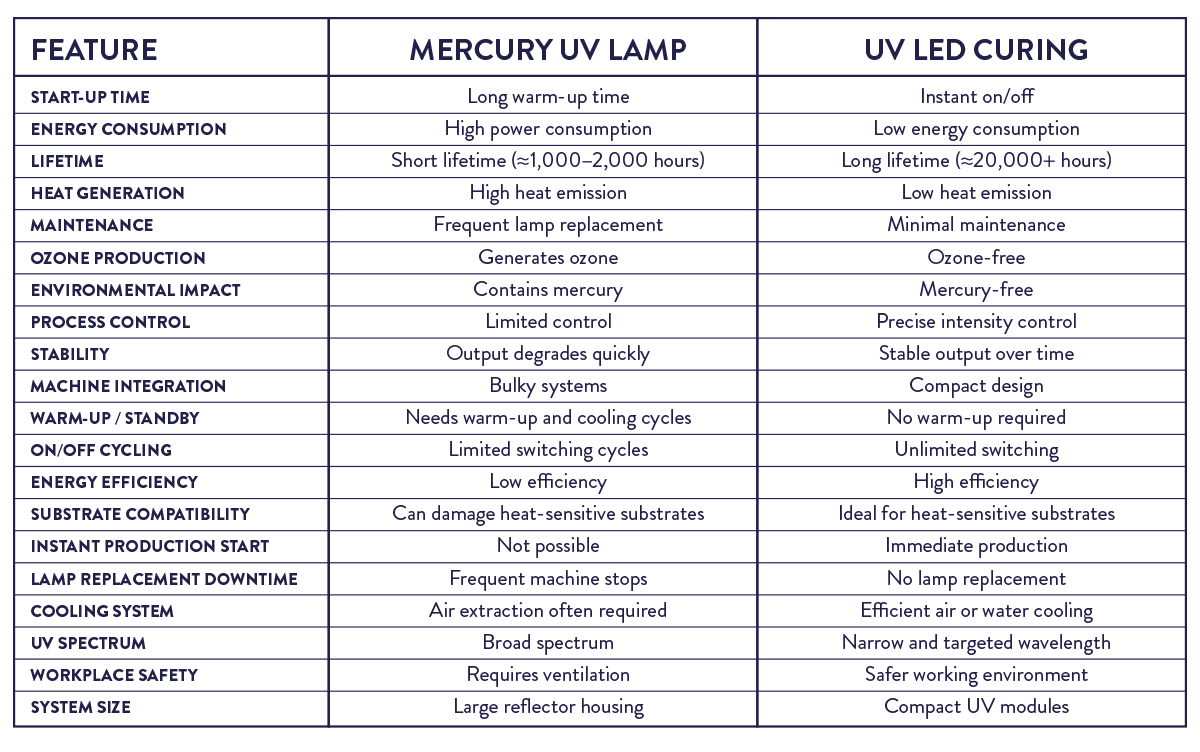
When comparing UV LED curing systems with traditional mercury vapor lamps, the differences become clear across multiple operational parameters.
Mercury lamps emit a broad spectrum of ultraviolet radiation, including wavelengths that are not always optimal for specific curing processes. In contrast, UV LED curing systems emit narrow-band wavelengths precisely tuned to match the photoinitiators used in modern inks, coatings, and adhesives.
This fundamental technological difference allows LED systems to deliver:
-
more precise curing energy
-
improved process stability
-
faster start-up times
-
lower energy consumption
-
reduced maintenance requirements
For industries operating high-speed production lines, these improvements translate into higher productivity, reduced downtime, and more predictable curing results.
While mercury lamps dominated industrial UV curing for decades, many manufacturers are now transitioning toward LED curing technology to improve both process efficiency and environmental sustainability.
Energy Efficiency: UV LED vs Mercury Lamps
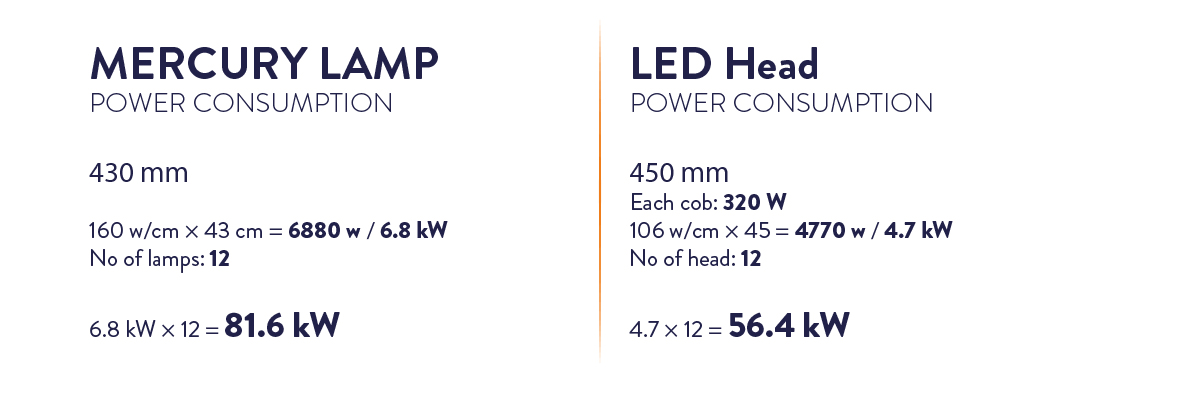
One of the most significant differences between the two technologies lies in energy consumption.
Mercury Lamp Energy Consumption
Traditional mercury vapor lamps require large amounts of electrical power to generate UV radiation. In addition to producing ultraviolet light, they also emit a substantial amount of heat and non-useful wavelengths.
This inefficiency leads to several operational challenges:
-
higher electrical consumption
-
additional cooling requirements
-
increased thermal stress on substrates
-
greater environmental impact
Because of this, conventional UV curing systems often require high-power electrical infrastructure and ventilation systems, increasing operational costs over time.
UV LED Energy Efficiency
UV LED curing systems are significantly more energy-efficient.
LED modules emit light only at specific wavelengths, typically between 365 nm and 405 nm, which are directly usable for curing processes. As a result, far less energy is wasted as heat or unwanted radiation.
Modern industrial UV LED curing systems can reduce energy consumption by 50–70% compared to traditional mercury lamps, depending on the application.
Lower energy usage also means:
-
reduced cooling requirements
-
lower operating temperatures
-
improved sustainability metrics
For manufacturers seeking to reduce operational costs and improve environmental performance, UV LED curing technology represents a major step forward.
Lifespan and Maintenance
Another critical difference between mercury lamps and LED curing systems concerns system lifespan and maintenance requirements.
Mercury Lamp Lifespan
Mercury lamps typically operate for 1,000 to 2,000 hours before their UV output begins to degrade significantly. As the lamp ages, irradiance decreases and curing performance becomes less predictable.
To maintain consistent results, operators must frequently replace lamps and recalibrate systems. This leads to:
-
regular production interruptions
-
higher maintenance costs
-
additional spare parts management
Lamp replacement can also generate downtime in high-value production lines, which directly impacts productivity.
UV LED System Lifespan
UV LED curing systems offer dramatically longer operational lifetimes.
High-quality LED modules can exceed 20,000 hours of operational life while maintaining stable irradiance levels. Because LEDs do not rely on gas discharge processes, they experience much slower degradation compared to mercury lamps.
This extended lifespan significantly reduces:
-
maintenance interventions
-
spare part costs
-
production downtime
For industrial operators, this means greater production reliability and predictable long-term performance.
Curing Speed and Irradiance Stability
Curing performance is determined not only by total power but also by irradiance stability and wavelength precision.
Mercury Lamp Spectrum
Mercury lamps produce radiation across a wide ultraviolet spectrum. While this can be useful in certain applications, it also introduces variability in curing efficiency depending on the ink or coating chemistry used.
Additionally, mercury lamps require warm-up times to reach optimal operating conditions. During this phase, curing performance can fluctuate.
UV LED Spectral Precision
UV LED curing systems emit highly controlled wavelengths, allowing the curing energy to be precisely matched to the photoinitiators used in modern materials.
This results in:
-
faster polymerization
-
more uniform curing
-
improved surface quality
-
better color stability in printing applications
Because LED systems reach full power instantly, they eliminate warm-up delays and allow operators to maintain stable production conditions.
Environmental Impact and Safety
Environmental and regulatory considerations are becoming increasingly important in industrial manufacturing.
Mercury Lamp Environmental Concerns
Mercury lamps contain mercury vapor, a toxic heavy metal that poses environmental and health risks if released. Disposal of mercury-based lamps must follow strict regulatory procedures to avoid contamination.
In addition, mercury lamps generate ozone and excess heat, which may require specialized ventilation systems.
UV LED Environmental Benefits
UV LED curing systems do not contain mercury or hazardous gases. This makes them inherently safer for both operators and the environment.
LED technology also contributes to sustainability goals by:
-
reducing energy consumption
-
eliminating hazardous waste
-
minimizing thermal emissions
For manufacturers working toward environmental certifications or ESG targets, LED curing technology represents a cleaner alternative to traditional UV systems.
Cost and Return on Investment (ROI)
Initial equipment cost is often one of the first factors evaluated by production managers.
Initial Investment
Traditional mercury lamp systems typically have a lower initial purchase cost compared to LED curing systems. For this reason, some legacy production lines still rely on mercury technology.
However, focusing only on initial cost does not reflect the full total cost of ownership.
Long-Term ROI of UV LED Systems
UV LED curing systems offer substantial operational savings over time through:
-
reduced energy consumption
-
longer component lifespan
-
minimal maintenance requirements
-
faster production cycles
These benefits often result in a rapid return on investment, particularly in high-volume production environments.
Many manufacturers that transition from mercury lamps to industrial UV LED curing systems report measurable improvements in productivity, efficiency, and process control.
Industrial Applications of UV LED Curing Technology
Although UV curing has historically been associated with printing and packaging, modern UV LED technology now supports a much wider range of industrial applications.
Advanced UV LED systems are increasingly used in:
-
industrial printing and packaging
-
label and flexible packaging production
-
electronic component manufacturing
-
adhesive bonding processes
-
coatings and surface treatments
-
advanced material processing
-
sterilization and decontamination systems
Thanks to their precision wavelength control and scalable system architecture, UV LED curing solutions can be engineered to meet the requirements of highly specialized industrial processes.
The Future of Industrial UV Curing
The shift from mercury lamps to LED technology is part of a broader transformation occurring across modern manufacturing.
Industries are increasingly demanding curing systems that are:
-
energy efficient
-
environmentally responsible
-
digitally controllable
-
reliable over long production cycles
UV LED curing technology addresses these needs by combining advanced optical engineering, intelligent control systems, and efficient power management.
As material science continues to evolve, the flexibility and precision offered by LED systems will enable new applications across sectors that go far beyond traditional printing.
Discover CurePro UV LED Curing Systems
CurePro develops advanced UV LED curing systems engineered for industrial reliability and process control.
Our solutions are designed to integrate seamlessly into both new production lines and retrofit installations, supporting a wide range of curing applications including printing, coatings, adhesives, and emerging industrial processes.
Through precision engineering of LED modules, power supply units, and control software, CurePro systems deliver stable irradiance, optimized energy consumption, and consistent curing performance across demanding production environments.
If you are considering the transition from mercury lamp curing to UV LED technology, our team can help you identify the most efficient solution for your specific application.
Through our global network of partners and distributors, CurePro is able to support customers and projects worldwide, combining centralized engineering expertise with local technical assistance.
Contact us and discover how CurePro UV LED curing systems can support your next generation of industrial processes.
CONTACTS
For product inquiries, technical service requests, supplier collaboration and distribution opportunities.