
COB vs POB UV LED Technology: Choosing the Right Solution for Industrial Curing
When designing a UV LED curing system, wavelength and nominal LED power are only part of the equation. Two systems operating at the same wavelength – for example 365, 385, 395 or 405 nm – can deliver very different results depending on the architecture of the LED module, its optical configuration and, above all, its thermal management.
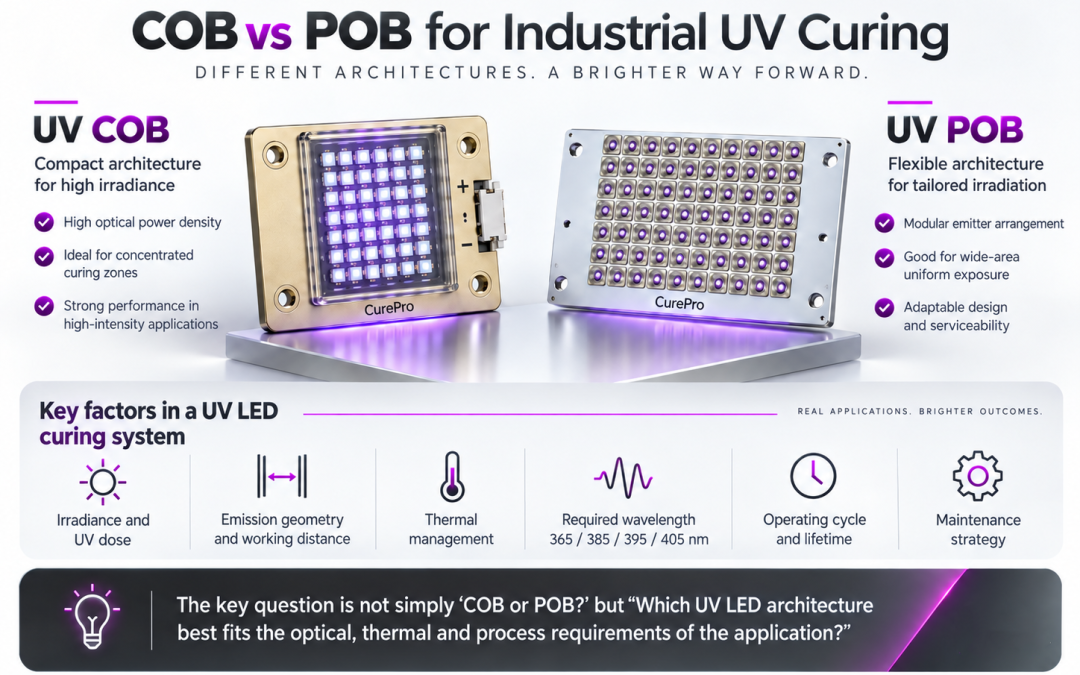
Among the technologies commonly used in high-power UV applications, COB (Chip on Board) and POB (Package on Board) represent two different approaches to LED integration.
Neither technology is universally better than the other.
The most effective solution depends on the actual curing process: required irradiance, exposure area, working distance, wavelength, operating cycle, cooling requirements and expected service life all have to be considered together.
For this reason, at CurePro we approach UV LED curing from a system-level perspective, selecting and integrating different technologies according to the requirements of each industrial application rather than relying on a single LED architecture.
Why LED architecture matters in industrial UV curing
In an industrial curing process, the objective is not simply to generate UV radiation. The system must deliver the correct amount of energy to the material, over the required surface, while maintaining stable operating conditions throughout production.
This involves several interconnected parameters:
-
UV wavelength;
-
irradiance at the working surface;
-
total UV dose;
-
exposure time;
-
emission geometry;
-
working distance;
-
thermal management;
-
optical uniformity;
-
duty cycle;
-
expected operating lifetime.
The way LED chips are integrated into the module directly influences many of these characteristics.
This is where the difference between COB and POB UV LED technology becomes relevant.
COB UV LEDs: compact architecture and high power density
In a Chip on Board (COB) configuration, multiple LED chips are mounted directly onto a common thermally conductive substrate.
Compared with architectures based on individually packaged LEDs, this reduces the number of interfaces between the semiconductor and the module substrate.
One of the main advantages is the possibility of positioning many LED chips within a relatively compact emitting area.
This makes COB technology particularly suitable when the UV curing process requires:
-
high irradiance;
-
high optical power density;
-
compact UV LED modules;
-
concentrated emission areas;
-
precise control of the emitting geometry.
Depending on the optical design, COB technology can be used to create point, line or area UV sources, making it suitable for a wide range of industrial processes.
The same high power density, however, also creates a significant engineering challenge: heat.
When a large amount of electrical power is concentrated into a small area, efficient heat transfer becomes essential. Substrate materials, thermal resistance, cooling system design and operating current must therefore be considered as part of the overall module architecture.
A high-performance COB source is consequently not defined by LED power alone. Its effectiveness depends heavily on how the entire thermal and optical system has been engineered.
POB UV LEDs: modularity and flexible light distribution
Package on Board (POB) technology follows a different approach.
Instead of mounting bare LED chips directly onto the substrate, individual LED devices are first packaged and then installed onto a board.
This provides greater flexibility when arranging the emitters.
Individual LEDs can be positioned according to the desired irradiation profile, allowing the designer to distribute UV energy across wider areas or create specific illumination geometries.
POB architecture can therefore be advantageous when the application prioritizes:
-
large irradiation areas;
-
highly uniform UV distribution;
-
flexible positioning of emitters;
-
modular system design;
-
easier component-level maintenance.
Because each LED is individually packaged, emitters can also be characterized and selected before being assembled into the final module.
From a service perspective, a modular structure may additionally make it possible to replace specific components without replacing the entire emitting unit, depending on the design of the UV curing system.
The trade-off is a more complex thermal path. Heat generated at the LED junction must pass through the individual package, its mounting interface, the board and finally the cooling structure.
For this reason, as with COB technology, actual performance depends on the complete module design rather than simply on the LED packaging method.
COB vs POB: the parameters that really matter
Comparing COB and POB only by looking at their construction provides an incomplete picture. For industrial UV curing, several performance parameters have greater practical importance, including irradiance, thermal management, irradiation uniformity, operating lifetime and maintenance requirements.
1. Irradiance and UV dose
One of the most important parameters in curing is irradiance, usually expressed in W/cm². Total optical power alone does not determine curing performance: a UV source may generate significant radiant power, but if that energy is spread over an excessively large area, irradiance on the substrate may still be insufficient for the process.
COB technology can be particularly effective when a high level of UV power must be concentrated into a limited area, while POB architectures provide greater flexibility when energy needs to be distributed across a larger working width. Irradiance, however, is only part of the equation: the material must also receive the correct UV dose, which depends on both irradiance and exposure time. The UV LED system therefore has to be designed around the actual process speed and curing requirements.
2. Thermal management
Heat management is one of the most critical aspects of any high-power UV LED curing system. As LED junction temperature increases, efficiency and optical output can decrease, while operating temperature can also influence wavelength stability and long-term degradation.
COB technology may provide a relatively short thermal path between the LED chips and the cooling structure. POB systems contain additional interfaces, but an appropriately engineered package and cooling system can still provide excellent thermal performance. What ultimately matters is not simply whether the module is COB or POB, but the overall junction-to-cooling-system thermal resistance and the junction temperature reached under real operating conditions.
This is why cooling technology must be considered an integral part of the UV LED curing system rather than an auxiliary component.
3. Irradiation uniformity
Not every process requires maximum peak irradiance. In many industrial applications, uniformity across the entire working area can be considerably more important, particularly for coatings, adhesives and surface treatments that require consistent UV exposure across wider areas.
POB architectures provide significant flexibility when designing this type of irradiation profile, while COB systems can also generate highly controlled emission patterns when combined with an appropriate optical system. In both cases, lenses, emission angles, LED positioning and working distance all contribute to the final irradiance distribution.
4. Operating lifetime
UV LED lifetime cannot be evaluated independently from operating conditions. High current density, elevated junction temperatures, long duty cycles and insufficient cooling can all accelerate degradation.
L70 is commonly used as a reference for LED lifetime and represents the point at which optical output has decreased to approximately 70% of its initial value under specified test conditions. However, a nominal lifetime value has limited meaning unless drive current, operating temperature, cooling conditions, wavelength and duty cycle are also considered.
There is therefore no automatic lifetime winner between COB and POB. Proper thermal engineering and appropriate operating conditions generally have a much greater impact on long-term performance than package architecture alone.
5. Maintenance and lifecycle cost
The purchase price of an LED module is only one component of the real cost of an industrial curing system. Maintenance requirements, production downtime, replacement procedures and service accessibility must also be considered.
A compact integrated COB unit can simplify the optical architecture and provide excellent power density, while a modular POB design may offer advantages when individual components need to remain accessible for maintenance or replacement. The most suitable solution therefore depends on the operating environment and on the impact that system downtime can have on the production process.
In many industrial installations, reliability and serviceability over the complete system lifetime are more important than the initial cost of the LED source itself.
Choosing the architecture according to the curing process
Instead of asking whether COB or POB is better in absolute terms, a more useful question is: what type of UV source is best suited to this specific industrial process? Different applications create very different requirements in terms of irradiance, geometry, exposure time, cooling and maintainability.
High-intensity and high-speed curing
Processes with short exposure times often require high irradiance within a relatively compact curing area. A carefully designed COB architecture can be particularly effective in these situations because a large amount of UV energy can be concentrated within a limited emission surface.
Large-area UV curing
When treating wider surfaces, the priority may shift from peak irradiance to uniform energy distribution. This can occur in industrial coating, surface finishing and other continuous production processes, where a POB configuration can provide greater freedom when positioning emitters across the curing area and adapting the system to the required working width.
Precision bonding and adhesive curing
Industrial adhesives often require highly controlled UV exposure. Depending on the component, the ideal solution may be a concentrated point source, an elongated line source or a wider irradiation area. The correct choice between COB and POB therefore depends primarily on the required irradiation geometry, wavelength, working distance and UV dose.
Continuous industrial production
Production environments operating for extended periods introduce additional requirements. Cooling efficiency, optical stability, module accessibility and maintenance strategy become fundamental parts of the system design, and choosing LED technology without considering the complete curing system can create unnecessary performance or maintenance limitations.
More than COB or POB: UV LED curing is a system
The distinction between COB and POB is useful, but it should never become the only criterion used when specifying an industrial UV LED system. A complete curing solution must take into account the interaction between LED technology, UV wavelength, optical configuration, irradiance, UV dose, working distance, curing area, cooling system, electrical power supply, process speed, integration requirements and operating environment.
These parameters are closely connected, and changing one can directly affect the others. This is why industrial UV LED curing should be approached as an integrated engineering problem rather than simply as the selection of an LED module.
CurePro: UV LED technology tailored to the application
At CurePro, we develop and integrate UV LED curing solutions for different industrial requirements. Rather than being tied to a single LED architecture, our approach is based on identifying the combination of LED technology, optics, cooling and power management that best matches the process.
Depending on the application, this may mean prioritizing high irradiance, achieving uniform exposure across a large surface, developing a compact curing module or adapting the system to an existing industrial installation. This technological flexibility allows UV LED curing systems to be configured for different materials, production environments and industrial processes.
Conclusion: the application should determine the technology
There is no universal answer to the COB vs POB comparison. COB technology can offer significant advantages when compact dimensions and high optical power density are required, while POB technology can provide greater flexibility when large-area irradiation, modularity and uniform light distribution are priorities.
Package architecture alone, however, does not determine the performance of a UV LED curing system. For industrial applications, the correct solution comes from evaluating the entire process: wavelength, irradiance, UV dose, geometry, working distance, cooling, operating cycle, lifetime and maintenance requirements.
Ultimately, the most effective UV LED curing technology is the one engineered around the application – not the other way around.
CONTACTS
For product inquiries, technical service requests, supplier collaboration and distribution opportunities.